Our Hour In The Sun
Rook Feld
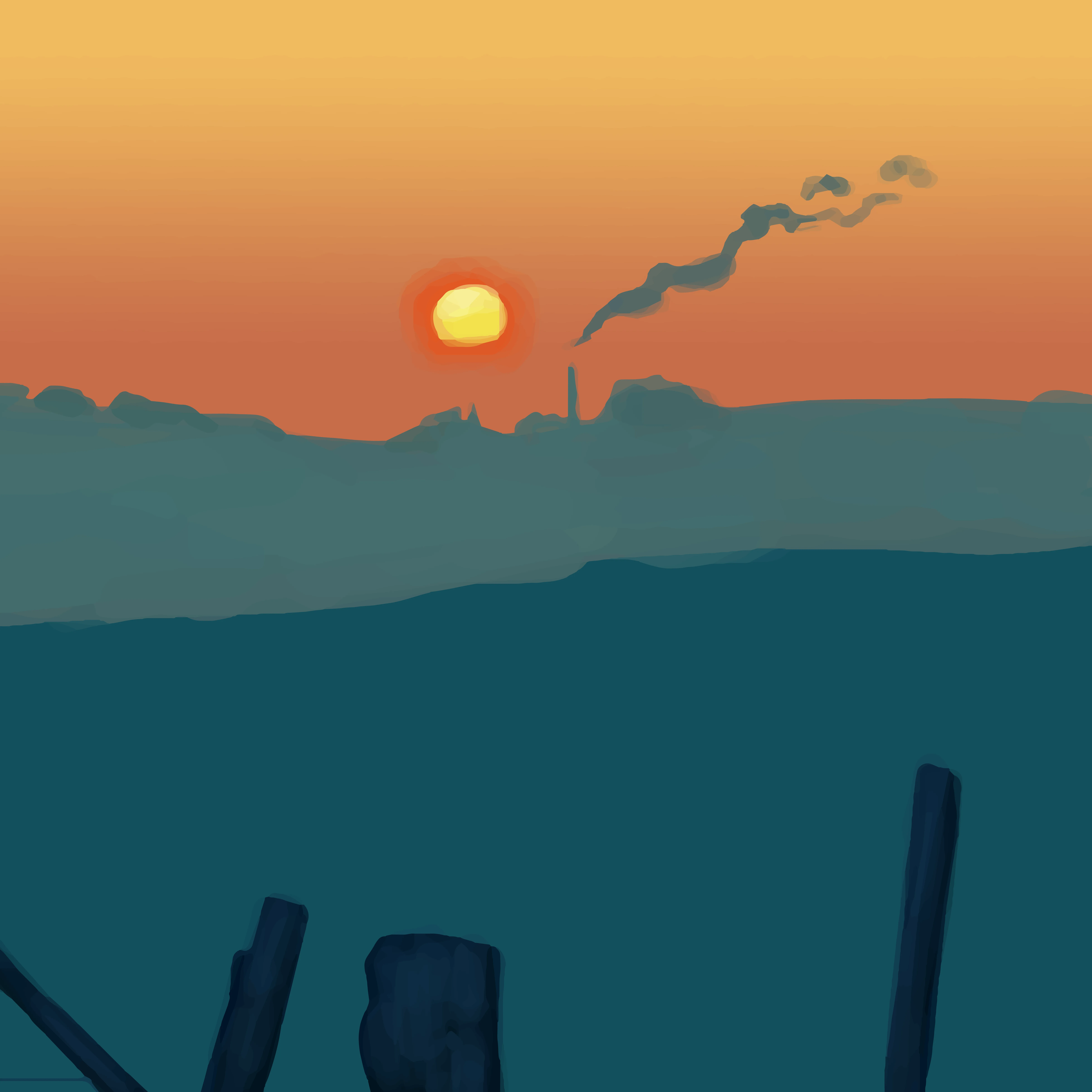
Judith looks out over the lake and imagines the carcass of a 1984 Subaru gathering algae on the bottom. She pictures it plunging into the water, carrying a family of four in its belly. She closes her eyes. They broke a window using the metal pegs on a headrest. Yes, Judith sees them sliding out between the shards, swimming up towards the green light and breaking through the surface and breathing in, their faces towards the sun. They all got out safe. She sees them on the shore, in the muck, embracing and crying and grinning whole-face grins. They sit at the dinner table, right now, talking about luck.
Here, the air is light and warm. Judith rests her hands on the wheels of her chair, raises her face to the cloudless sky, and imagines an airplane. It tips over in the blue and careens down towards Earth. She wills into the existence the crash and the miraculous survival of every single passenger. She imagines a baby found in a tree after a tornado, unscathed and cooing. She imagines a cat emerging from the rubble of a burned-down apartment complex.
“Judy?”
A hand on her shoulder, immaculate lilac fingernails.
“Judy, are you enjoying the lake?” It’s that nice young lady, Sophia or Sylvia, the caregiver who knows how to fold paper animals and always smells like citrus. That’s right – Judith told them she wanted to go someplace with wide water.
“Yes,” she says. “Thank you.”
“Would you like me to bring you back to the home now?”
There’s something measured in the young woman’s voice, a manufactured brightness. Judith swivels towards her and smiles. “No, dear. You go be with your loved ones. I want to stay here.”
Loons warble their ghost-songs.
“Are you sure?”
“It can’t be more than an hour now. You go, say your goodbyes.”
There is nothing more to say. Judith feels the caregiver’s hand squeeze her shoulder and then disappear. She turns back to face the water, which shines like a mirror in the light. She imagines a young man on a motorcycle. He’s going a little too fast, and he fishtails, and his bike veers right and hits the curb, and he’s thrown forward through the summer air thrumming with cicadas, under a glassy sky, over green grass, towards a tree. She tries to imagine that he does not hit the tree. She runs the scene over and over in her mind, but every time, she must cut it short because he is about to hit the tree. No matter what she does. He is going to hit the tree.
One hundred and sixty-three keys hang on the western wall of Walter’s apartment. Recently, Walter has found himself sitting at his desk, holding a pen centimeters above the paper, and staring straight ahead at that wall. He sits there for what might be hours, tracing the contours of each key with his eyes. He does not move on to the next until the current key has been thoroughly inspected, and he does not write a word until he has finished.
He is about halfway through. The clock ticking in his kitchenette serves as a metronome to keep this ritual on pace. Sunlight comes in through the eastern window and slides across the key wall, glinting off the rustless ones. That one there, he decides, is the key to the cellar of an ancestral mansion. And that one opens a trunk filled with collectible Rubik’s cubes. That one is for a walk-in freezer, that one is for a panic room. Walter taps his pen against the desktop, in time with the ticking clock. One less second, one less second, one less second.
When the news came, he knew he had to write something extraordinary. The draft is finished, it’s right there in front of him, but every single word feels like a lie. And it will never be put onstage. And his son will never see it. And this is why, when Walter finishes with the last key, he lets his eyes drift back up to the top left corner of the wall to begin again.
That one opens a garden gate. That one shines so bright in the sunlight, it’s driving a needle into his eye. Without thinking, Walter has gone to the wall and plucked that key off its nail. He holds it up, within inches of his face. This one is for a tiny room somewhere, with black walls and perfect cubic dimensions and a faint scent of chlorine, where Walter can go lock himself in, and eat the key, and sit there with his eyes closed and his knees pulled up to his chest, waiting out this remaining hour without thinking about his son. His son, sitting on the couch with his legs flung over the armrest, staring at the ceiling and wondering where his dad is. Or maybe – his son, eating corn flakes at the kitchen table and thinking about how he used to sit on his father’s shoulders and tug on his ears to steer him around and around the driveway. Or – his son, who has not thought of his father in years, and good for him.
Now, Walter has pulled dozens of keys off the wall. He holds them in his arms, and some spill out and clatter to the floor as he runs across the room to the eastern wall. He pulls the front of his shirt out like a sling and cradles the jumble of keys, just like he did as a boy, running barefoot and carrying slippery stones from the creek up to his house, where he dumped them out on the porch and sorted through them with his father, who would blow cigarette smoke out through his nose and hold a stone up to the sun and say, “There’s a keeper.”
Walter opens the window and climbs out onto the fire escape. The air is still, and he can’t hear a single car. Of course, no one is on the roads today. Walter picks a key, reels back, and hurls it off the fire escape. Again, he throws another as far as he can. He does not look to see where they land. Again, again, until his arm aches and the keys he once held are all gone and Walter realizes he has been sustaining one long, wordless yell. This isn’t what he wanted. None of this is right.
He leans out far over the railing. The metal scalds. He stays there, folded, stomach pressed into the railing, arms pulled down by the monumental force of gravity, and he listens to the clock ticking. Sometimes, his feet float up off the fire escape, and he balances with one half of his body out over the abyss. Walter teeters there for a long time, picturing the fall.
Instead, he stands back up, and the blood that had rushed to his head drains out. Spots dart and fizz in his peripheral vision. He climbs through the window, picks up his script off the desk, and kicks keys aside on his way to the door. Walter holds the script to his chest and leaves his apartment for the last time.
Raoul and Caleb are following ants. They make slow progress across the pavement, lugging a pot of molten aluminum and making sure to step over every crack in the sidewalk. The sinew in their scrawny arms is pulled taut with the weight of the metal, and they move in shuffling, sideways half-steps. They are looking for the anthill. All this – the melted Pepsi cans, the burnt knuckles, the sweat – is for science. They told themselves they would do this, they promised each other, and now is their last chance.
They find the hill behind an old backyard shed, where the ground is covered with acorns and the surrounding trees lean over to watch them work. They place the pot on the ground and set about building a short dirt wall encircling the anthill. As they work, they watch the ants skitter wild loops in the dirt, and Raoul expresses a moment of remorse for the poor bastards. You’re only supposed to do this with abandoned anthills, but oh, well. And Caleb says yeah, but we’re just doing to them what God is about to do to all us human people. Maybe these ants didn’t pray hard enough to us.
They laugh, and now they’re talking about what if we’ve got it all wrong? Because why would some big all-powerful all-knowing thing need us to praise it all the time? What’s with the worship? Because God made us, you moron. Okay, but like. What if I made a video game that was so good the virtual people were basically just like us real people? I wouldn’t care if they worshiped me or not. Yeah, but it would be pretty cool if they did, right? Wait, you’re saying God wants us to do all this shit because it’s cool? No, yes, that’s dumb, no it’s not. Why would we pray if God just made a game and let it run? You can still edit code. You’re crazy. No, yes. So there’s a teeny-tiny chance – woah! Watch where you’re splashing that stuff, dickhead! So there’s a teeny-tiny chance God will happen to be paying attention to you at any given time because it’s not all-powerful, it’s just some dude making a computer program. Wait, but we forgot about time. Wherever God is, maybe time doesn’t work the way our time does, like it all happens all at once or something. Then they’d be listening to everyone.
Steam rises in wisps around them as they pour the aluminum into the anthill. It smells like the time they burnt Raoul’s hair off with that firecracker, when their families went camping together, and everyone got poison ivy from the “blanket” they made out of leaves, and Caleb tripped on a root and knocked his two front teeth out. Raoul could swear he hears the ants sizzling, but that’s definitely in his head.
“This isn’t fair,” he says. “It’s not enough. I feel like I don’t know anything.”
The trees sigh in the wind.
“I feel like I’ve just been going along,” Raoul continues. “I think maybe if I had more time…”
He trails off and kicks an acorn, sending it flying past the anthill. Caleb wants to put a hand on his friend’s shoulder, but it seems insufficient. All their years of shared experience also seem insufficient. Useless, but Caleb speaks anyway.
“Well, my rabbi says–”
“Oh, your rabbi says?”
“–shut the fuck up.”
“Your rabbi says ‘shut the fuck up?’”
“You’re a real pain in my left buttcheek. He says it’s all about transformation.”
Raoul looks at a cluster of surviving ants, crawling in circles around each other.
“What’s that supposed to mean?”
“You know, changing.”
They sit on the ground and draw dragons in the dirt with sticks.
The aluminum has cooled. The boys untie the rusty shovels from each other’s backs and drive them into the ground to dig up their creation. They will rip it from the earth, sneak home with it, hose off the dirt, and beneath, they’ll find a gleaming sculpture, a collaboration between child and nature, thousands of tiny ant-souls trapped within. Then they will take a long look at it, trying to memorize the labyrinth of tunnels, how the sunlight reveals a porous texture in the metal. Then they will probably part ways and go to their families, who will wail with relief. And Raoul will probably sit in the living room, which smells like smoke and toast with peanut butter and honey, and he will probably hold hands with his mother and his grandparents, who will probably tell him to shut his eyes and pray. And Caleb will probably lie down with his head on his dog’s stomach and feel the animal breathing in and out, while his mother lights candles and his father calls an old high school friend for the last time. This, most likely, is how they will say goodbye.
As a girl, Sylvia would sit at the table in her mother’s sun-speckled kitchen, stare at a jar of jelly, and demand that reality become more than mediocre. She was sure that all she needed to do was want it enough, and then slowly, against the massive, frictional force of reason, with the grinding hum of glass on wood, the jar would begin to move.
Some small part of Sylvia has always considered it a personal failure, not a failure of the universe, that the jar never budged. And this itches in the back of her mind as she looks at Judy for the last time. The old woman’s hair like a tangle of spider silk, moving in the summer breeze, her wrinkles like woodgrains on a door, her back upright in the wheelchair. Sylvia had always looked forward to time spent keeping Judy company at the residence home. She would watch as Judy held a pencil in her hand and drew wobbly alpine landscapes and birds sitting on telephone wires that looked more like lines on a heart-rate monitor. Judy once told Sylvia about her years spent housekeeping – first to help with her parents’ mortgage, then to pay for an art history degree, then to pay the rent, because “no one ever bought a mansion with encyclopedic knowledge of Neoclassicism, honey.” She told Sylvia about the importance of posture when one spends all day stooped over, cleaning under the rug and sweeping up dust. Here, on the lakeshore, Judy looks like a fixture of the landscape, her presence inevitable and necessary. She had begged to spend this day near water, and how could Sylvia deny a request like that? Marlene had said no, of course. No, no, please stay here with me. Please, you don’t need to work today. Today, of all days.
Sylvia walks to the van without looking back. She climbs into the driver’s seat and, out of habit, looks over her shoulder to make sure all her passengers have their belts on. Nothing but the distant sound of loons and the smell of cinnamon gum. Of course, Judy was the only one who wanted to go out today. The rest of the residents were either picked up by relatives weeks ago, or they chose to stay in the home and spend their time looking at faded photographs or placing thousand-dollar bets on Scrabble games until the clock reaches zero. In a way, she envies them. The residents have been coming to terms with the end for a while now, and here she is, trying to catch up.
The streets are empty all the way back to the residence home. As she parks, everything around her feels too sharp, too bright to be real, like a photo enhanced beyond recognition. The white parking lot lines cut across the black asphalt, crisp and precise, and she feels like she can see far beyond the reaches of her peripheral vision. She can see every vein in every leaf, feel every variation in texture on the steering wheel, hear every individual note in the bird calls.
Five blocks separate Sylvia and the subway station. Every day, her legs take her there without input from her brain, and even today, muscle memory takes over. She passes a woman walking with a toddler on her shoulders and two boys carrying a pot filled with dirt and a man lying on his back in the grass, reciting poetry. As she approaches the station, the velvet peel of a saxophone floats out from the tiled corridors. She realizes she could’ve just driven the van home to Marlene. It wouldn’t have been theft; no one needs it anymore. She should’ve done that. There can’t be much more than an hour left now.
Sylvia quickens her pace, takes the steps down into the subway two at a time. There is a man on the tracks. He stands among sheets of paper, splayed out around him. The KING exits stage right, at the top of one page. Trumpets. Curtain. He is crying the way children cry – red-faced, drooling, in heaves and sniffles, with all requirements of the adult world stripped away. Aside from herself, this man is the only soul on the platform. The screens show no arrival times. Of course, why would they be running today? The saxophone echoes from the corridor, like a sound traveling across miles and miles of open ocean.
She walks to the edge and kneels. The man does not turn to look at her, but she can tell by the way he inhales that he knows she’s there. She speaks quietly. “What are you doing?”
“I’m looking for an event,” the stranger says. He is middle-aged, sunken, and the way he looks straight ahead reminds Sylvia of an unblinking fish staring through aquarium glass. He gasps, sobs subsiding for a moment. “This isn’t what I wanted. I’m looking for an event to transform all this.”
“Well, you’re about to get it.”
“Oh,” he says, an exhalation. “There’s no train coming. I just always wondered what it was like down here. I thought maybe if I stood here, I could internalize – I could – I don’t know, figure out. I don’t know what I was expecting.”
Sylvia recognizes something in this stranger’s face.
“What are you thinking about?”
The man curls in on himself. “My son.”
“Where is he?”
“Eleven blocks north.”
“So why are you here?”
“Coward.” He places a hand on his chest and speaks the word like an introduction.
“Well,” Sylvia says.
She reaches down towards him, and he winces when he takes her hand, like her grip is enough to break bones. She pulls him up. He leaves the script behind, scattered across the rails. A play in three acts. Together, they walk out of the station and back into the sunlight, and Sylvia puts a hand on each of his shoulders, turning him to face her. They do not have much time.
“Run,” she says.
The man looks at her with eyes that see through to the center of her ribcage, where she keeps her child-self, who is still waiting for something wonderful and impossible. The stranger nods, and turns away.
Sylvia begins to run towards home, towards Marlene, her wife, collector of sitcom DVDs, hater of limes and her own birthday, savior of discarded furniture and knick-knacks, who gives her students extra credit for doodles in the margins, who is surely sitting on the couch right now, staring and breathing evenly, thinking where is she where is she where is she where is she. Sylvia runs past teenagers perched in trees, past a house blaring hip hop and show-tunes simultaneously, past a screaming priest and drunken kite-flyers and silent houses with the shades drawn, and she imagines the man from the subway running in the opposite direction. She imagines him reaching his ex-wife’s house and leaning his head against the door, the red door, and gasping for air, and smelling daffodils. She imagines a boy running to meet him at the threshold, leaping into his arms, and the man lifts his son up into the air, where he throws out his wings and soars, like an airplane. Sylvia decides this is the truth.
Only a few more blocks now, and oh, remember when she and Marlene got in that fight over cereal brands? When they moved here, so Sylvia could work with people at the end of their lives and Marlene could work with people at the beginning? Or when they got lost in Yosemite, or when the flood destroyed all of Sylvia’s childhood artifacts in the basement, or when they fed the pigeons or spent a whole day speaking in written notes? And then, she is home, and falling into Marlene’s arms, and Marlene is holding her, saying how could you, how could you, and Sylvia doesn’t have the words to explain why she needed to go into work one last time today, to take an old woman to the lake and let her see the broad water. She doesn’t know how to explain that Judy needed to be on that shore, like the horizon needs to extend from one end of your vision to the other. She crumples to the wooden porch floor and leans her forehead against Marlene’s and closes her eyes.
Caleb’s head rises and falls as the dog breathes. Raoul is praying – not in pleas, but in memories. The time he stood just four feet from a herd of deer, the time he got nine runs in one game of kickball. The time his father told him about the size of a whale’s heart. That was long ago, before his dad walked out the back door, head down and face hidden under a navy blue baseball cap. Raoul remembers the wind chime hanging on the back porch, and he remembers the bright sound it made before his father pulled the door shut behind him. Walter is thinking of this moment, too, as he steps up to the front door. He braces himself for how much older Raoul will look. A wind chime speaks in his memory as Walter raises his hand to knock.
Sylvia kisses her wife’s forehead, then her right temple. She kisses her eyelids and her cheeks and her mouth while across the world, a calico cat curls up in Rajan’s lap and listens to him sing, and elsewhere, Georgette sits in scuba gear at the bottom of her pool, and Nnedi slow-dances with her husband of sixty years, and Judith looks out over the glistening lake and imagines a young man on a motorcycle getting home safely. She cannot remember her mother’s face. She cannot remember what it feels like to run, or swim in the ocean, but somewhere miles away, a young man on a motorcycle tears down an empty road with green all around, and dust glowing in the sun. Here, the air is light and warm. He savors the smell of pine needles and the hum of cicadas. He breathes in, and everyone breathes in with him as the ground begins to shake, and somewhere a jar of jelly slides across a tabletop, and the sky goes white and there is unfathomable warmth and together, every human and oak and fruit fly – every living thing – ends.